
Beyond the Hummingbirds: The Extraordinary Birdlife of Mindo

Updated: Oct 27
BEYOND GUIDE · ECUADOR
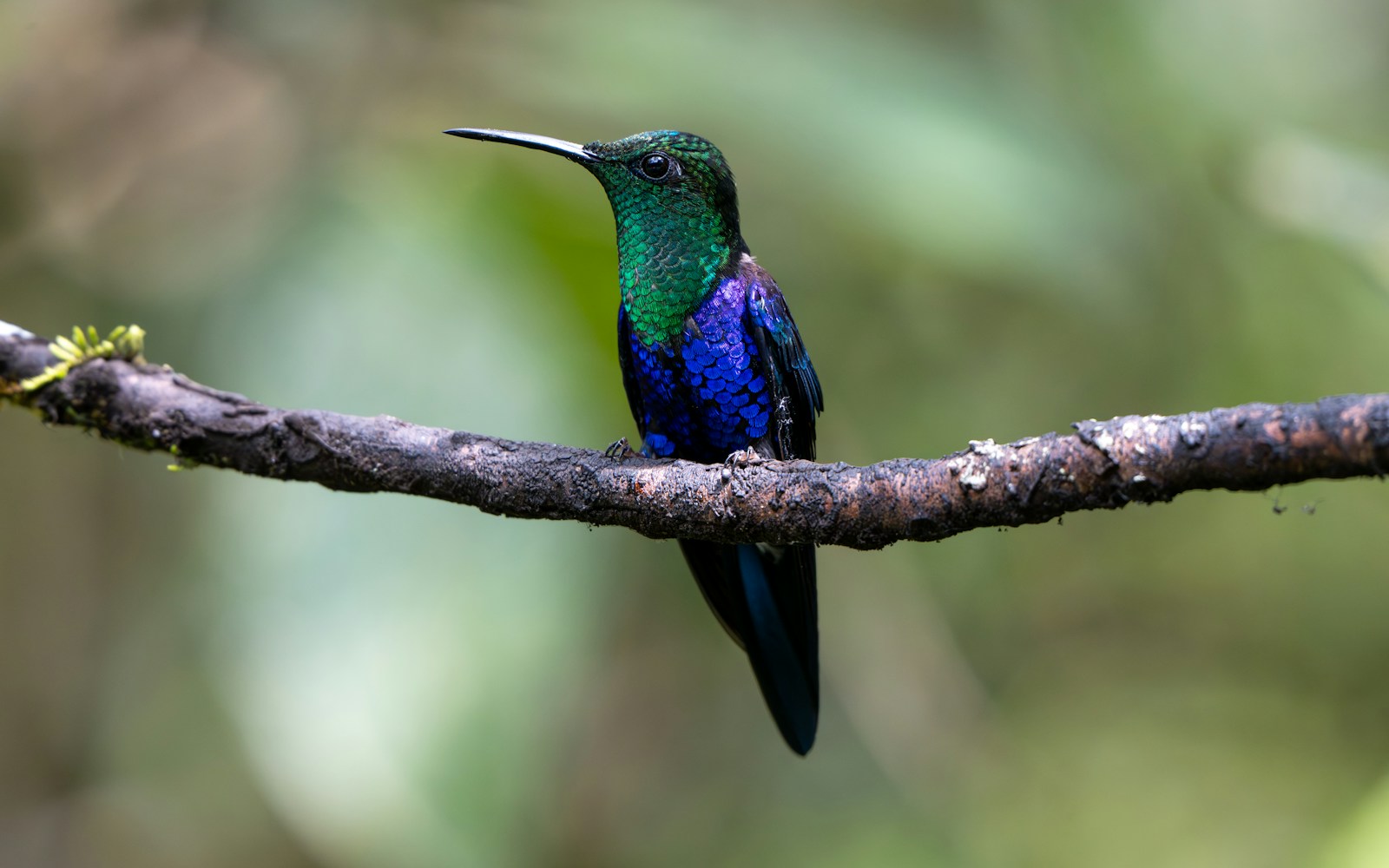
A hummingbird photographed in Mindo. Its colours are only one part of the story of cloud-forest birdlife.
The first thing you notice about birdwatching in Mindo might be the hummingbirds: streaks of iridescent colour arriving at flowers or feeders so quickly that your eyes barely keep up. I could quite happily lose a morning to that alone. But the real magic is when someone points towards a branch you were certain was empty and suddenly there is a toucan sitting in plain sight. Somewhere deeper in the trees another bird is calling, and a small flock moves across the canopy. It is less about ticking off obvious animals and more about learning how much you were missing five minutes earlier.
Mindo's birdlife is extraordinary, but the huge species numbers are only part of why it interests me. Altitude, forest, food, sound and behaviour all affect what is around you and where you find it. Understand even a little of that and a walk through the forest becomes much more interesting, whether you consider yourself a birder or, like me, simply someone who gets very excited by wildlife.
BEYOND THE BROCHURE
The question I would ask before arranging a birdwatching experience is not, 'How many species will I see?' It is, 'What kind of observation do I want?' A hummingbird garden, a forest trail and a dawn visit to a cock-of-the-rock display offer very different experiences, even within the same region.
Why are so many birds found around Mindo?
Mindo sits on the western slopes of Ecuador’s Andes, where the mountains meet the extraordinarily biodiverse Chocó region. What makes that especially interesting is how quickly the landscape changes. Gain or lose elevation and the temperature, moisture, vegetation, flowers and fruit can change with it. For the birds, that means different ecological niches over surprisingly short distances. For us, it means moving a relatively small distance can produce a very different morning's birdwatching.
You will see some enormous species numbers attached to Mindo, sometimes more than 500 for the wider birding region. I would not choose a trip on that number alone. Those lists can span several elevations, habitats and surrounding reserves, not the patch of forest beside one lodge. What I find much more interesting is why the number is possible in the first place: so many different habitats packed into a relatively small area.
Why a small range can make a bird more significant
Some birds of the Chocó-Andean region have very restricted ranges. That may sound like terminology for serious birders, but it has a much bigger meaning. If a species depends on a narrow band of habitat, what happens to that landscape matters enormously. Suddenly 'endemic' is not just an impressive word on a species list; it helps explain why connected forest at different elevations is so important.
The Andean cock-of-the-rock: a bird that puts on a performance
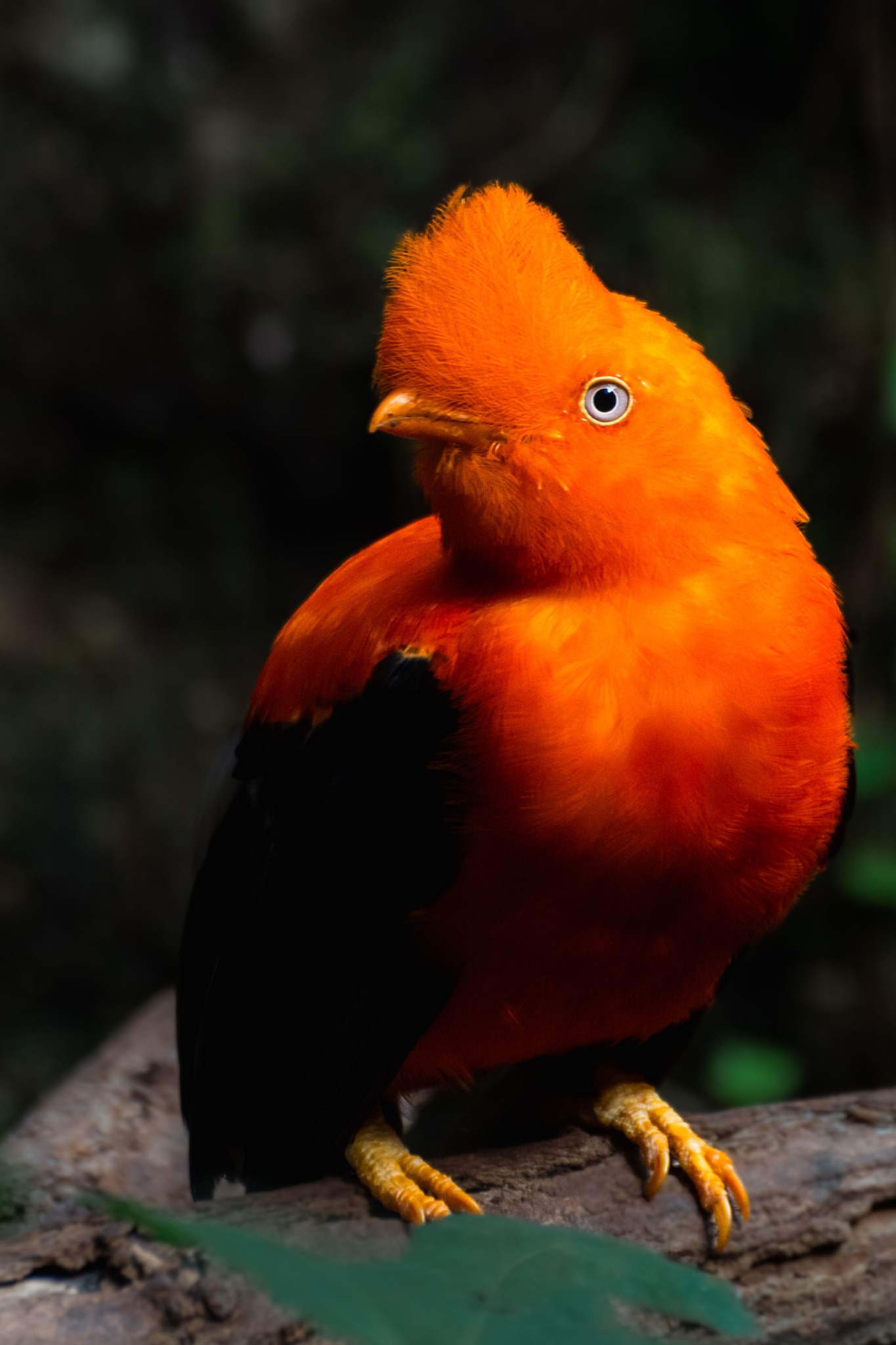
Male Andean cock-of-the-rock, noted for its striking crest and courtship displays.
A male Andean cock-of-the-rock is, frankly, a fairly ridiculous-looking bird in the best possible way: brilliant orange-red plumage and an almost improbable rounded crest. The behaviour is even better. Males gather at traditional display grounds known as leks, calling and displaying while females assess potential mates. The males compete for attention rather than helping to build the nest or raise the young. So this is not just a spectacular bird to photograph; you are watching sexual selection play out in the forest.
A visit to an active lek generally means an early start, a local guide and careful behaviour near the observation site. Viewing depends on access arrangements, weather and the birds. Silence, patience and staying in designated areas matter more than being the closest person with a camera. It should never be sold as a guaranteed performance.
Toucans are not all the same bird
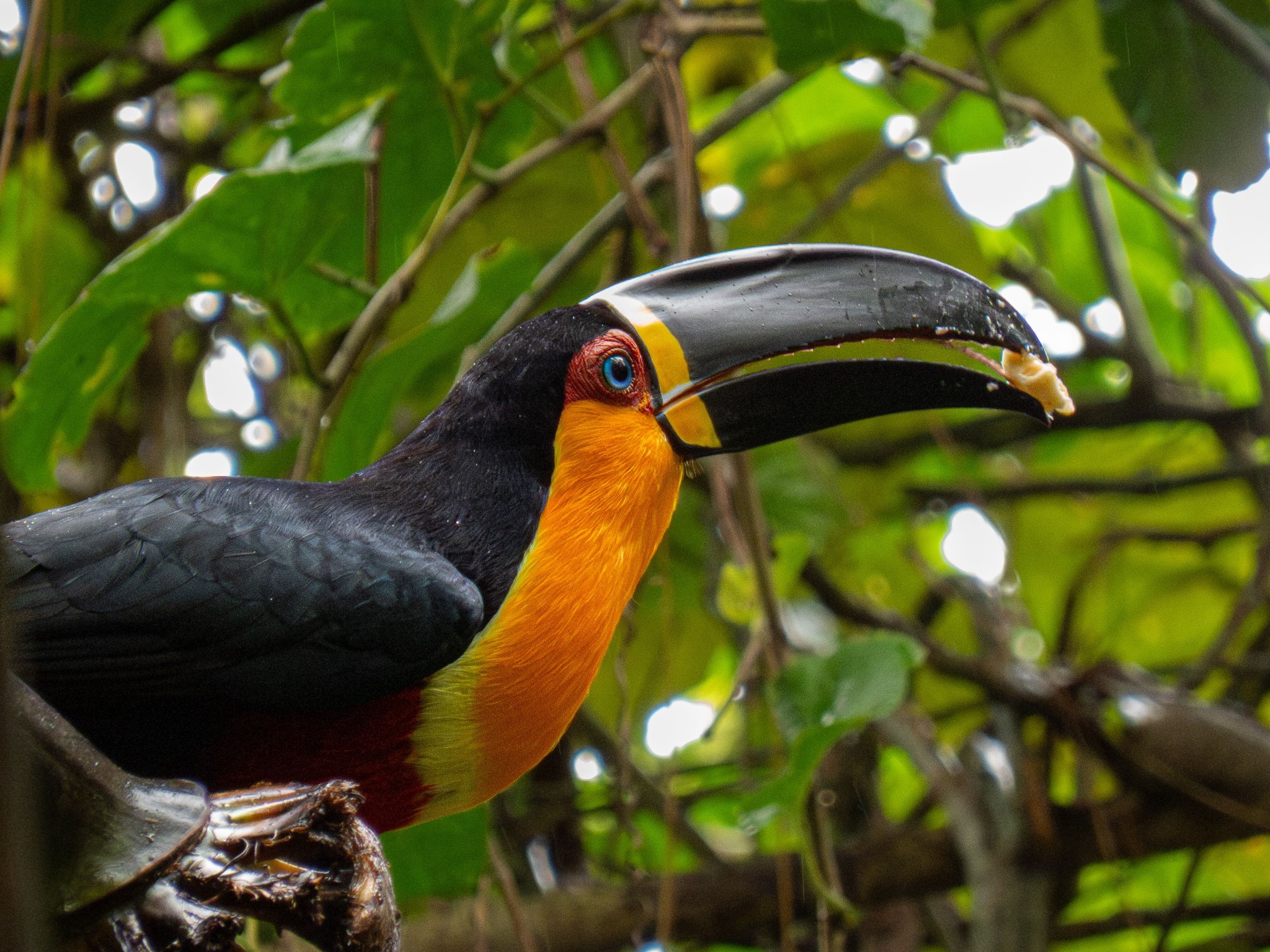
Toucan photographed in tropical forest. An illustration of the varied toucan family, not a documented Mindo sighting.
The classic toucan bill is instantly recognisable, but Mindo is not home to one generic 'toucan'. The wider western-Andean birding region includes birds such as the Yellow-throated Toucan, smaller toucanets and aracaris, as well as the extraordinary Toucan Barbet. And, just to make identification slightly less convenient, the Toucan Barbet is not actually a toucan at all. Knowing some of these differences makes a distant bill in the canopy far more interesting than simply ticking 'toucan' off a list.
Different species favour different elevations and habitats, and some are much easier to hear than to see. A good guide will distinguish between a bird calling across a valley and one you have a realistic chance of finding along the trail you are walking. If a particular species matters to you, ask where it has been observed recently, at what elevation and whether the outing is actually designed for that habitat.
The underrated pleasure of a mixed flock
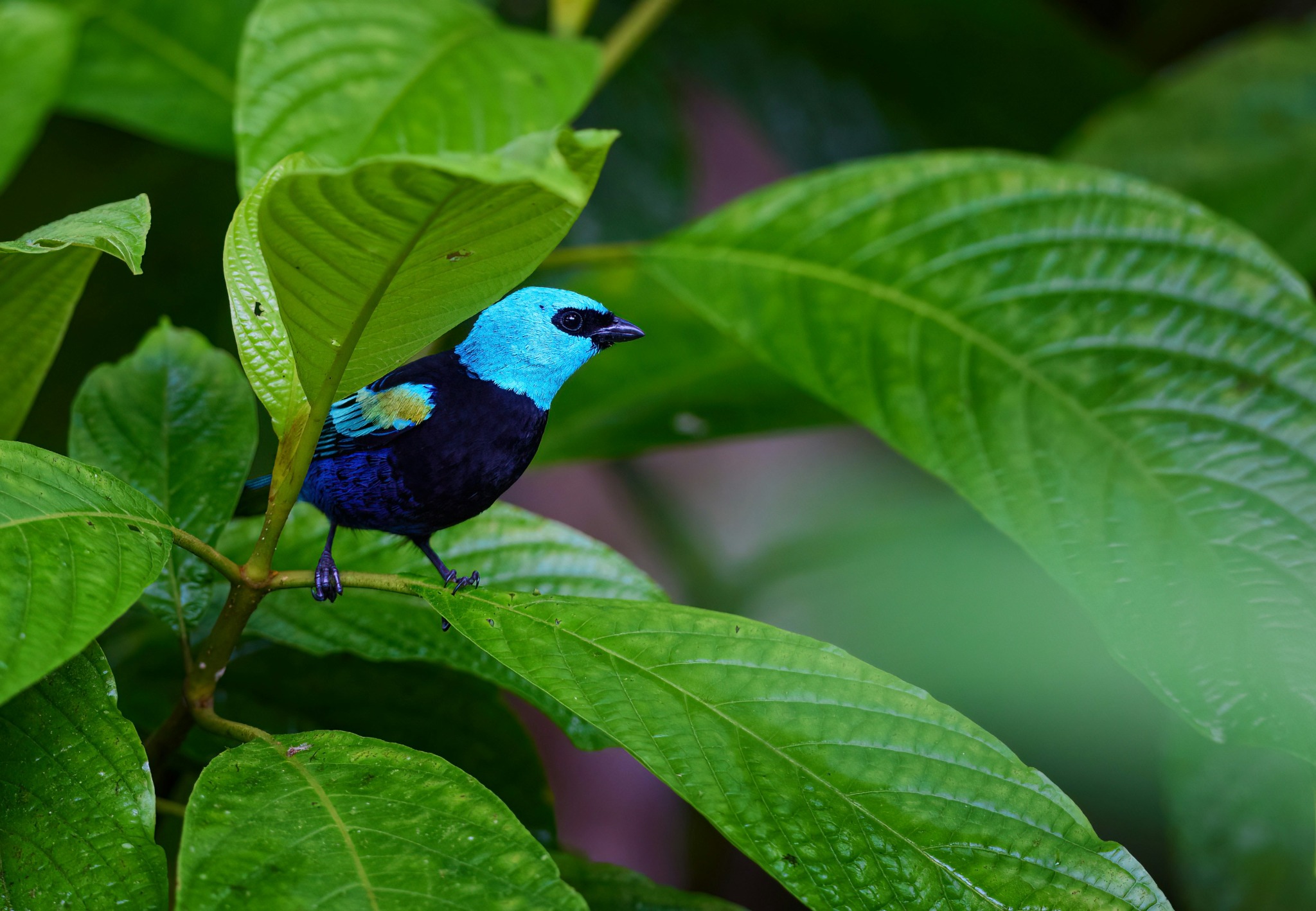
A brightly coloured tanager, one of many birds that can be encountered in Neotropical forests.
One forest event I would particularly love to encounter is a mixed-species flock: several species moving and feeding through the forest together. They are not all competing for exactly the same meal. Different birds search leaves, bark, branches or different levels of vegetation, while travelling together can also mean more eyes and ears detecting danger. A patch of forest that appears to be doing absolutely nothing can become intensely busy within seconds.
Tanagers may flash through the foliage while less conspicuous birds work the branches around them. You cannot schedule a flock to appear on cue, which is part of the appeal. Waiting and listening matter. A guide who recognises calls and movement before the birds become visible can turn a few frantic seconds into an explanation of how several species are using the same forest. I find that far more interesting than simply coming home with a longer list of names.
A bird that makes music with its wings
The Club-winged Manakin is one of those natural-history facts that sounds slightly made up until you learn how it works. The male does not rely on song alone: specialised wing feathers vibrate against one another at remarkable speed to produce a high-pitched mechanical sound. It is a brilliant reminder that birdwatching here is not just about colour. Sometimes the extraordinary bit is something you hear first and then need somebody to explain.
Hummingbirds: the detail behind the colour
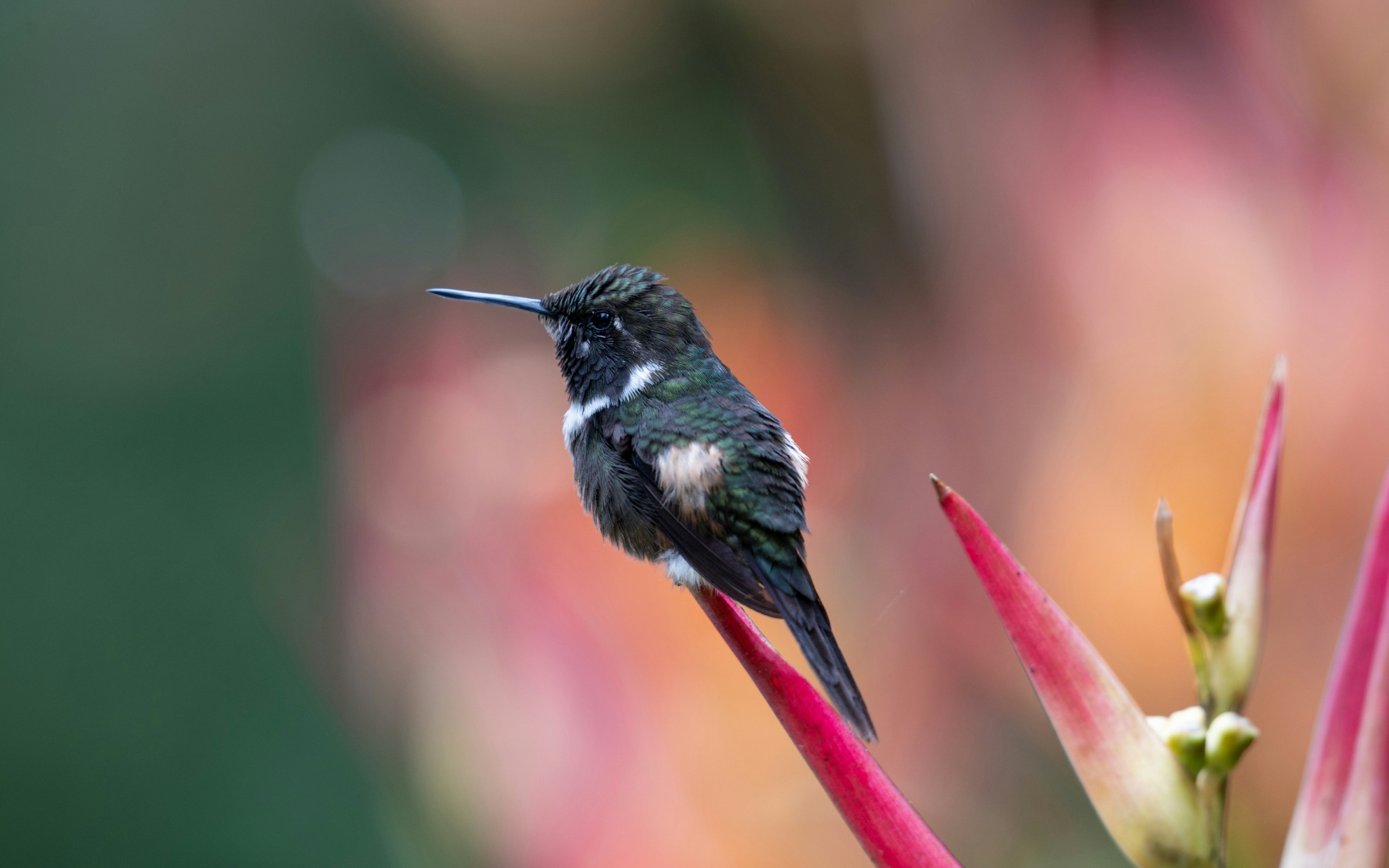
Hummingbird resting among tropical flowers.
Hummingbirds have enormous energy demands and remarkable flight abilities, but they do not all use the forest in the same way. Mindo's changes in elevation, vegetation and flowering plants create different feeding opportunities over relatively short distances. Bill length and curvature can affect which flowers a bird can reach efficiently, while the flowers themselves may have shapes and nectar rewards that favour particular pollinators. It is the sort of detail I love: once you start looking at the flower as well as the hummingbird, the whole interaction becomes more interesting.
There is plenty of drama around a good patch of nectar too. One hummingbird may repeatedly chase rivals while another sneaks in more opportunistically at the edges. Rather than trying to photograph every arrival, spend ten minutes watching one perch or flowering plant and see what develops. Feeding stations can give extraordinary close views and are brilliant for noticing differences in size, bill shape and plumage, but they are a managed window into hummingbird life, not the whole story.
Why birdsong can be more useful than binoculars
Dense cloud forest hides birds remarkably well, which is why sound matters so much. Calls can reveal that a flock is approaching or alert a guide to a bird long before anyone sees it. You do not need to memorise dozens of songs. For me, the fascinating bit is the moment you realise that a forest you thought was quiet is actually full of information; you simply had not learned how to hear it yet.
This is a reason to choose a patient guide rather than someone promising the longest possible species list. Good guiding includes interpreting what is happening and adapting the pace to the people in the group, not racing ahead to the next sighting.
What to expect if you're not a birdwatcher
Some sightings will be spectacular and obvious. Others will be a moving silhouette, a tail disappearing into foliage or a call from a bird that stubbornly refuses to show itself. That is normal. Binoculars help, but curiosity matters more than technical knowledge. A half-day with a skilled naturalist can be rewarding even if you never learn the names of every tanager. If you are new to birdwatching and want to know what a first guided outing actually feels like, read You Don't Have to Be a Birder to Go Birdwatching in Mindo.You Don't Have to Be a Birder to Go Birdwatching in Mindo.
If you particularly want close views and photographs, say so when booking. A session using a well-managed feeder garden may be more satisfying than a demanding forest trail. If you want behaviour and habitat, a quiet guided walk or targeted dawn outing will offer something different. Neither is a lesser form of birdwatching.
The bird you came to see might not appear
Wild birds have not read your itinerary. Weather, season, flowering and fruiting, breeding behaviour, time of day and simple chance all affect what appears. A species seen regularly last week may be quiet today, and the cock-of-the-rock, toucan or tanager you particularly hoped for may never give you the perfect view.
I actually think that uncertainty is part of what makes wildlife travel exciting. You are watching wild animals, not arriving for a scheduled performance. A morning that misses its 'target' bird might instead produce a mixed flock, an unfamiliar call or a behaviour nobody set out to find. Good guiding makes those unexpected moments feel like discoveries rather than consolation prizes.
How to birdwatch without changing the birds' behaviour
Stay on established trails and follow site rules. Avoid crowding nests, using flash close to sensitive birds or approaching a displaying lek too closely. Recorded-call playback can alter bird behaviour, particularly around breeding or territorial birds, so responsible use depends on species, place and circumstance. It is reasonable to ask a guide whether they use playback and how they decide when not to. Playback should not be used simply to lure a bird closer for a photograph, and wildlife should never be moved or baited for a better shot.
There is a bigger conservation story behind all this too. Forest protection, restoration and local employment can make bird tourism economically meaningful. I am naturally quite sceptical of a sustainability label on its own, though. I would rather know what a lodge is actually doing: how it looks after habitat, whether local guides are involved and what tangible practices sit behind the marketing.
Choosing a lodge when the birds are the main attraction
When birds are a major reason for choosing Mindo, I think of accommodation as part hotel choice, part habitat decision. I would ask three things before booking: what can genuinely be watched from the property itself; which habitats or elevations need a vehicle or separate excursion; and whether specialist outings, such as an early visit to a cock-of-the-rock lek, are included or arranged separately. I love the idea of drinking coffee while hummingbirds turn up around the lodge, but excellent feeders do not automatically make somewhere the best base for every species you hope to see.
I've deliberately given Mindo proper time on my own Ecuador itinerary for 2027 rather than squeezing it into a quick stop. Partly that is because wildlife and natural history are a huge part of why I travel, and partly because I want time for both the easy pleasure of watching birds around the lodge and outings further into the forest. A hummingbird garden, a forest trail and a specialist dawn excursion can reveal very different sides of the same cloud forest.
The point isn't to become a birder
The photographs may be what first draw you to Mindo's birds: a scarlet cock-of-the-rock, an iridescent hummingbird or the improbable bill of a toucan. They certainly work on me. But the more I learn about the cloud forest, the more interested I am in what is happening between those headline sightings: birds competing for mates, following food through different layers of forest, defending flowers, travelling in mixed flocks and responding to habitats that change with elevation.
You do not need to come home from Mindo having become a birder. You may, however, find yourself paying far more attention to a rustle in the canopy than you did before. For me, that is the appeal: not collecting names for the sake of it, but becoming curious enough to realise how much is happening around you.
FURTHER READING
Sources for further exploration: Mindo Tourism's birdwatching guide, local birding-area information from El Monte, Casa Divina's published tour programme and Mindo Lindo's conservation work. Wildlife sightings are never guaranteed and reported bird lists cover different geographical areas.

Comments