
You Don't Have to Be a Birder to Go Birdwatching in Mindo

Updated: Oct 27
BEYOND GUIDE · ECUADOR
For some people, 'birdwatching' sounds like a hobby you need to understand before you are allowed to join in: expensive binoculars, lengthy checklists and people who can identify a distant silhouette in seconds. In reality, your first birdwatching morning may involve standing beside a path while somebody whispers, 'third branch down, just left of the pale leaf', and wondering how everyone else can apparently see a bird that is completely invisible to you. Then you find it. That small moment of discovery is much closer to what beginner birdwatching feels like.
Mindo is particularly well suited to trying it because birdwatching does not have to mean a specialist expedition. You can spend twenty minutes watching hummingbirds, take a slow naturalist walk or head into the forest at dawn with a guide. This guide is about what those experiences actually feel like and how to choose one you will enjoy.
BEYOND THE BROCHURE
Before choosing an outing, forget the advertised species count for a moment. Ask yourself what would make the experience enjoyable. Do you want close, colourful views? A quiet forest walk? Photographs? Help learning how to use binoculars? Or the excitement of searching for something that may only appear for a few seconds? There is no “proper” way to begin. The best first birding experience is the one that matches how you like to experience nature.
What actually happens on a birdwatching walk?
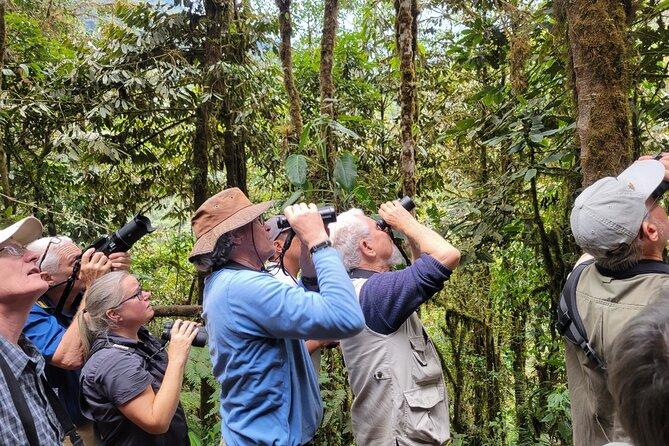
A guided birdwatching group searching the canopy in Mindo’s cloud forest.
A guided morning often begins with much less walking than people expect. You move a little, stop, listen and wait. Your guide may hear a bird before anyone sees it, point towards an apparently empty tree, or ask the group to stay still because something is moving through the foliage. There can be long quiet patches followed by thirty seconds in which several birds seem to appear at once. Birdwatching has a rhythm of its own, and accepting that rhythm is part of enjoying it.
The hardest part at first is often not identifying a bird but simply finding it. Guides use landmarks and birding shorthand to direct your eyes: 'top of the dead tree', 'two o'clock from the fork', 'low in the understory'. Canopy means the upper layer formed by tree crowns; understory is the shaded vegetation below. You are not expected to know the vocabulary. Ask someone to point again. Everyone has stared at the wrong branch.
Three ways to start, and why they aren't interchangeable
A hummingbird garden or feeder observation
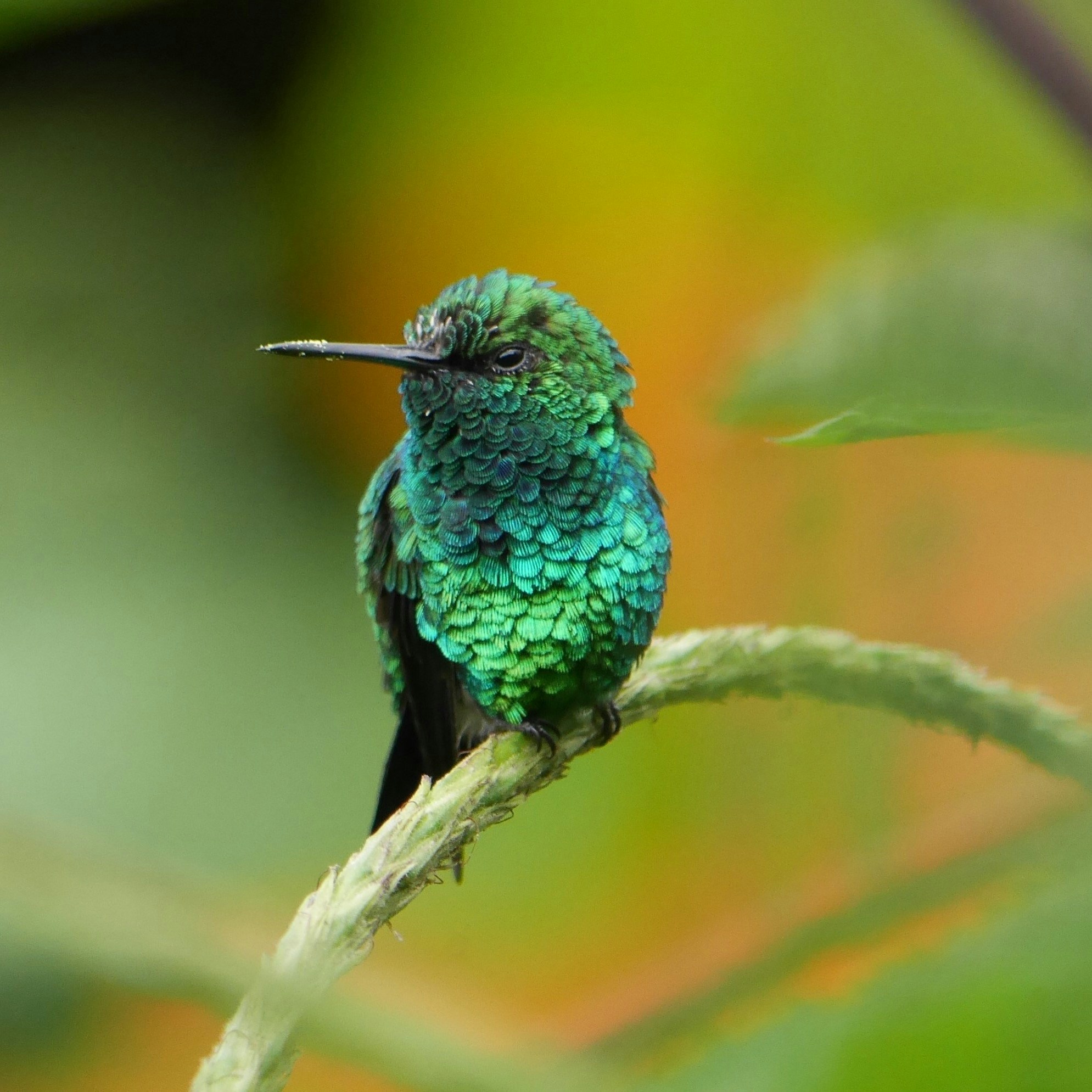
Hummingbird perched on a branch. Birdwatching can begin with a few quiet minutes of observation.
This is often the easiest introduction because the birds come to you. You can watch colour, flight and squabbles over feeding positions without trying to locate a tiny bird in a huge tree. It suits people who want close views, photography, a shorter session or somewhere they can spend time without covering much ground. The trade-off is that you are observing birds around a managed food source, not experiencing the full forest.
A gentle naturalist trail
This suits people whose interest is really nature rather than birds alone. A slow trail might produce hummingbirds and tanagers, but also insects, orchids, tree ferns, frogs or simply a better sense of the cloud forest itself. There is less pressure to find a particular species. “Gentle” is subjective, though: in a wet cloud forest, gradients, mud, roots and slippery surfaces matter. Ask what the path is actually like rather than relying on the label.
A specialist dawn birding outing
This is closer to what many people imagine when they hear “birding”: an early start, quieter observation and more deliberate searching in a particular habitat. You may see something extraordinary, or spend ten minutes looking for a bird that remains stubbornly behind a leaf. It rewards patience more than expertise. Choose it because the process of searching sounds appealing, not because somebody has promised you a long list of species.
What should you bring? Less than you might imagine
You need surprisingly little. Comfortable closed shoes with grip, light rain protection, water and clothes you can stand quietly in matter more than specialist equipment. Binoculars make an enormous difference, but ask whether your guide or lodge lends them before buying a pair. For many beginners, 8× binoculars offer a useful balance between magnification, field of view and steadiness. The best binoculars are ultimately the pair you can focus quickly and comfortably.
A phone camera can record the setting and occasional close view, but small birds in dim forests are difficult subjects. If photography is a central goal, ask about observation decks, feeder setups and whether your guide understands photographers' needs. A long camera lens cannot make wildlife behave to order.
How to get more from your first sighting
When a guide spots a bird, do not immediately sweep your binoculars around the canopy. First find the location with your naked eyes. Pick a landmark such as a broken branch, pale leaf or fork in the trunk, keep looking at it and then bring the binoculars up to your eyes. If you lose the bird, lower them and start again. This sounds trivial, but it is one of the biggest differences between a frustrating first half-hour and actually beginning to see what the guide sees.
Once you find the bird, give yourself a few seconds before reaching for a camera or asking its name. Watch what it is doing. Feeding? Calling? Chasing another bird? Sitting motionless despite its outrageous colouring? Behaviour is often easier to remember than a name, and it gives you something to notice the next time.
The questions I'd ask a Mindo birding guide
Useful questions are practical rather than technical. How many people will be in the group? Is it genuinely suitable for complete beginners? How much standing and walking is involved? Are binoculars available? Is there somewhere to sit? What happens if it rains? Is photography compatible with the pace? If you struggle to locate a bird, will the guide slow down and help? If a hoped-for species does not appear, does the outing adapt rather than simply rush to another site?
One question matters particularly: how does the guide work with beginners? Expertise and guiding skill are not quite the same thing. Someone can identify hundreds of species and still be poor at helping a first-timer find a bird. Patience, clear directions and enthusiasm for ordinary sightings can matter more to your experience than the length of the guide’s personal bird list.
A note on comfort, access and the early start
Yes, dawn can be excellent for bird activity, but 5am is not a compulsory initiation ceremony. If a pre-dawn start would make you miserable, say so. A shorter session around lodge grounds, an accessible feeder site or a later naturalist walk can still be rewarding. Check seating, toilets, trail gradients, transfers, weather cover and how long you are actually expected to be on your feet. Accessibility should shape the experience, not exclude you from it.
Where you stay can shape the experience
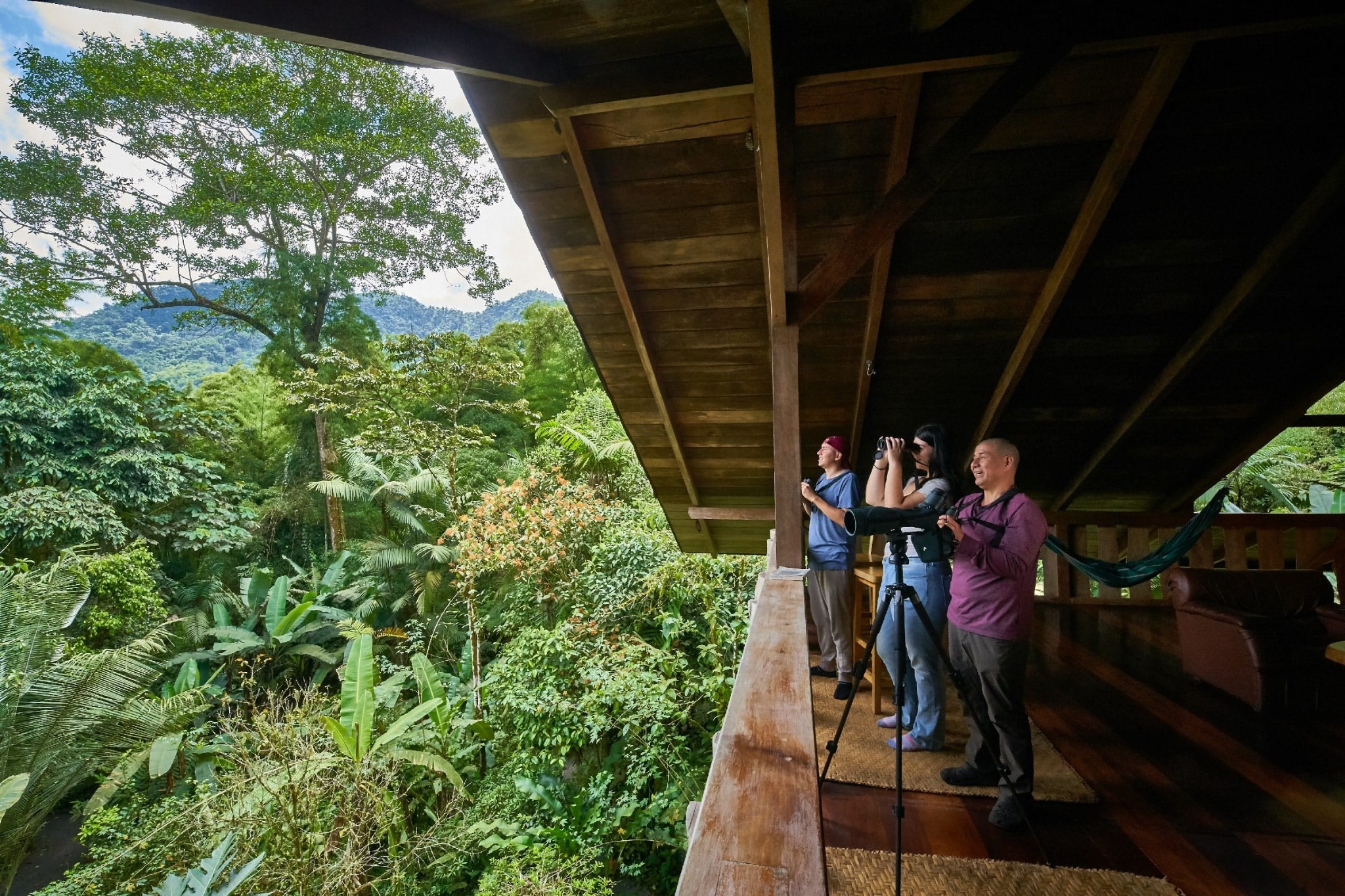
Birdwatching from the terrace at Casa Divina Eco Lodge, Mindo. Photo courtesy of Casa Divina.
Where you sleep can affect how deliberately you have to go birdwatching. At a forest lodge, the first sighting of the day might happen over coffee rather than on an excursion: something calling from the trees, hummingbirds around flowers or movement at the forest edge. Staying in town gives easier access to restaurants and independent activities but may mean travelling to particular habitats. Neither is inherently better. The useful question is whether you want birdwatching woven into your stay or contained within specific outings.
Birdwatching etiquette that matters
The basic etiquette is simple: the bird’s welfare comes before the photograph. Keep a respectful distance, stay on established paths and follow restrictions around nests and courtship sites. Do not ask anyone to move, bait or repeatedly disturb a bird for a better view. Guides may sometimes use recorded calls, but playback can alter behaviour and should be used judiciously rather than simply to pull a bird closer. Quiet groups also tend to notice more.
The best outcome isn't a longer bird list
Your first birdwatching morning does not need to end with a list of fifty species. Success might be learning how to bring binoculars onto the right branch without losing the bird. It might be noticing that one hummingbird keeps chasing another from the same flowers. Or realising that the guide stopped walking because they heard something you had not yet learned to hear.
You do not have to become a birder afterwards. But once somebody has shown you how much is happening in a tree that initially looked empty, it can be surprisingly difficult to stop looking.
FURTHER READING
For the natural history behind the experience, read the companion Beyond Guide: Beyond the Hummingbirds: The Extraordinary Birdlife of Mindo. For current local information, Mindo Tourism publishes birding resources and individual reserves and lodges publish their own access and guiding details. Conditions, schedules and accessibility can change, so confirm practical arrangements directly.

Comments