
The Forest in the Clouds: What Makes Mindo's Ecosystem Extraordinary?

Updated: Oct 27
BEYOND GUIDE · NATURAL HISTORY
A cloud forest can feel slightly unreal. Clouds drift between the trees rather than above them. Moss covers branches until it becomes difficult to tell where one plant ends and another begins. Orchids and bromeliads grow overhead, water gathers on leaves and somewhere in all that green, things are calling that you cannot see.
It would be easy to describe Mindo as simply beautiful. But that misses what makes a cloud forest extraordinary.
The mist matters. So does the altitude. The plants growing on other plants matter. The birds eating fruit, the fungi breaking down what falls to the forest floor and even the water collecting in the leaves of a bromeliad are parts of the same system.
And perhaps that is the real magic of a cloud forest. The closer you look, the less it becomes scenery.
BEYOND THE BROCHURE
You do not need to know the name of every orchid to get absorbed by a cloud forest. I certainly don't. What interests me is understanding enough to notice what is happening around me: where the water is going, why plants are growing on other plants, and what is feeding on what. Once you start asking those questions, an apparently tangled wall of green becomes a living system.
A rainforest with its head in the clouds
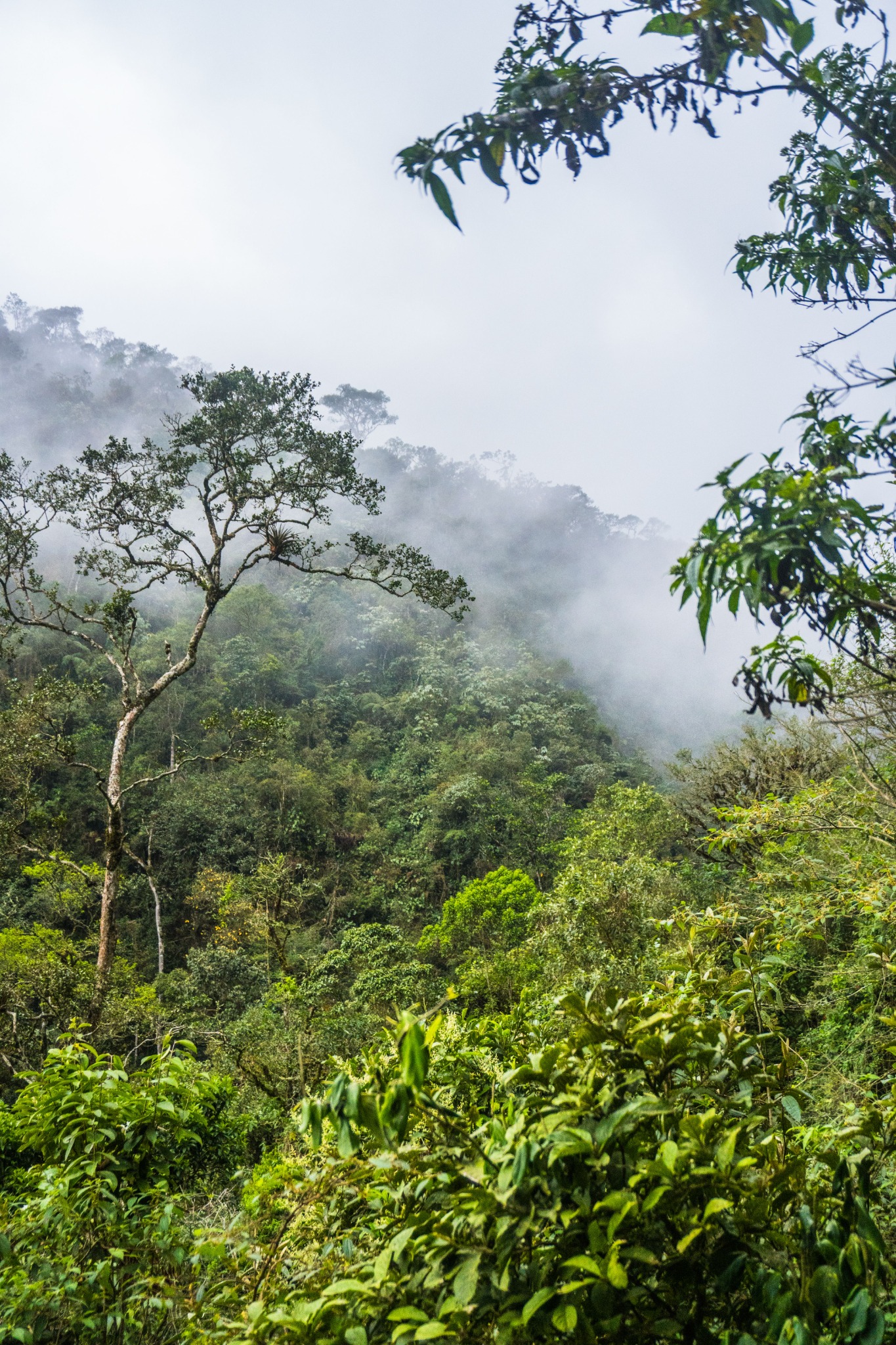
Cloud drifting across a forested slope, illustrating the moisture characteristic of cloud-forest habitats.
Tropical montane cloud forests are forests at elevation that experience regular immersion in low cloud or mist. That sounds like a small distinction from an ordinary rainforest, but having clouds move through the vegetation changes the conditions in which plants and animals live.
Moisture arrives as rain, but it can also arrive suspended in the air. Leaves, mosses and branches intercept tiny cloud droplets as mist passes through the canopy. Some of that water gathers on vegetation and eventually drips towards the ground. Researchers call this cloud-water interception or fog interception. The forest can collect water directly from passing cloud.
How important that intercepted water is varies with elevation, wind, season, forest structure and local climate, so it would be misleading to suggest every cloud forest behaves identically. That variation is part of the point. Cloud forest is not one neat band of permanently misty trees. Conditions can change over surprisingly short distances.
A garden growing on another garden
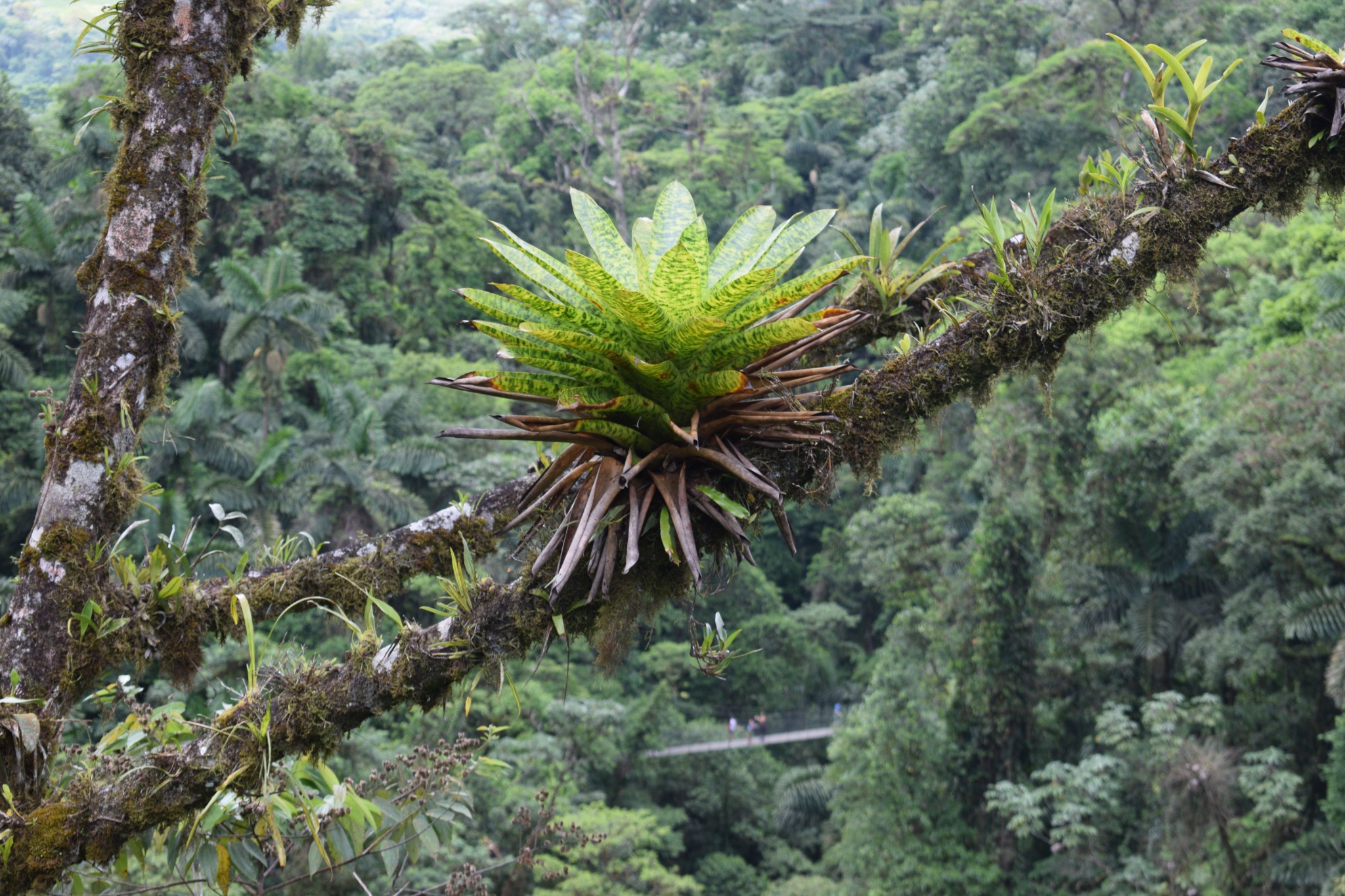
A tree becomes growing space for other plants, including bromeliads, mosses and smaller epiphytes.
One of the things I find most fascinating about a wet forest is how much life is growing above the soil. Look closely at a branch and the tree may appear to be carrying another garden: orchids, bromeliads, ferns, mosses and lichens layered across bark and forks.
Many of these are epiphytes. They use another plant for physical support without feeding from it in the way a parasite would. Instead, they obtain water and nutrients from rain, mist, airborne material and organic debris that collects around them. A branch therefore becomes much more than a branch. It becomes growing space.
Bromeliads make this particularly easy to imagine. In some species, overlapping leaves form a tank that can hold rainwater and fallen material. These small reservoirs can become habitats in their own right. Mosses, meanwhile, hold moisture across bark and branches. The forest floor has effectively been multiplied upwards into the canopy.
This is the sort of detail I can happily disappear down a rabbit hole over. A tree is an organism, but it is also architecture for other organisms. A plant can be habitat as well as plant. What first looks like decorative greenery is actually part of the structure of the ecosystem.
Why a short journey uphill can change the forest
Elevation alters temperature and moisture, and those changes influence vegetation. A warmer lower slope does not necessarily support the same plant community as forest further uphill. Flowering and fruiting patterns change. So can the birds, insects and other animals able to use those plants.
This helps explain why the wider Mindo region can support remarkable biodiversity while any one trail shows only part of it. Species lists gathered across several elevations and habitats should never be mistaken for a checklist a visitor can expect to see beside one lodge. For a closer look at the birdlife itself, see Beyond the Hummingbirds: The Extraordinary Birdlife of Mindo.
It also changes how I think about accommodation. I would much rather know what kind of forest surrounds a lodge, and what habitats a good guide can reach from it, than simply be told it is 'in the cloud forest'. Two beautiful properties can offer quite different wildlife experiences because of elevation, vegetation and access.
The forest is constantly being rebuilt
The relationships become even more interesting when you stop looking at individual species. A hummingbird moving between flowers may transfer pollen. A fruit-eating bird may carry a seed away from the parent plant. Fungi and other decomposers break down fallen material, returning nutrients to the system. Roots hold soil on steep slopes while new growth competes for light above them.
None of these relationships is as tidy as a nature documentary diagram, which is partly why I find them so interesting. A colourful bird visiting a flower is not automatically pollinating it, and one flower is rarely dependent on one perfectly matched visitor. Watching what an animal is actually doing can tell you far more than photographing it and immediately moving on.
A fruiting tree is a particularly good place to stop. Different visitors may arrive, feed in different ways and leave in different directions. Somewhere in that ordinary-looking sequence is part of the mechanism by which a forest renews itself.
The world beneath the obvious one
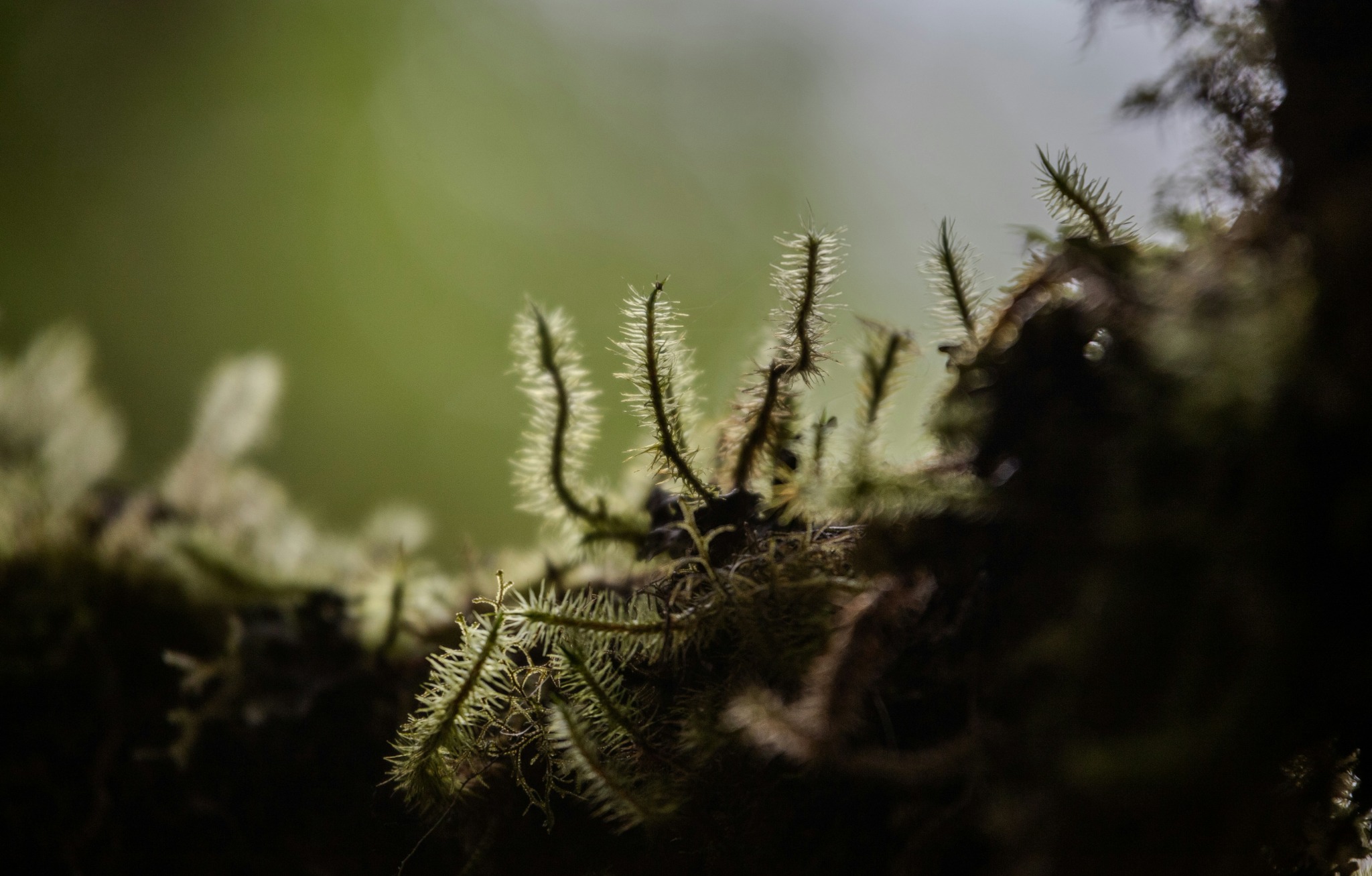
Small plants growing within moss, an example of the minute habitats found on forest surfaces.
Cloud forests reward looking at small things. Fungi, leaf litter, rotting wood and soil organisms rarely receive the attention of a hummingbird, but the forest could not function as a permanent accumulation of living material. What dies has to become available to life again.
On the ground, moisture softens fallen material while fungi, microorganisms and invertebrates help break it down. On steep terrain, roots and intact vegetation also help bind soil and influence how water moves through the landscape.
Even the mud tells you something. A wet, slippery path may be inconvenient, but it is also a reminder of the conditions supporting the mosses, ferns and epiphytes around you. Staying on established trails matters precisely because roots, soil and small plants are easy to damage when everyone looks for a cleaner route around the puddle.
What disappears when forest becomes fragmented
The value of cloud forest extends well beyond providing somewhere beautiful to walk. Montane forests provide habitat, influence water regulation and help stabilise steep soils. Their ecological relationships also depend on having enough suitable habitat for species to feed, breed and move through the landscape.
That is why fragmentation matters. A patch of forest can remain visibly green while becoming more isolated from the habitat around it. Roads, agriculture and other land conversion can divide continuous forest into smaller areas, changing forest edges and making movement more difficult for some species. Climate change adds another pressure because cloud formation, temperature and moisture are tied to elevation. Some species adapted to particular conditions may have less suitable habitat available as those conditions shift.
A peer-reviewed study using satellite imagery and a machine-learning model estimated that 0.61 square kilometres of tree cover, or 1.17% of its approximately 52-square-kilometre Mindo study area, was lost between August 2019 and July 2021. That is a historical model-based estimate for a defined area, not a current deforestation rate for the whole Mindo region. Its significance goes beyond the headline number: even a destination celebrated for nature tourism exists within a changing landscape.
Conservation is more complicated than an eco-lodge label
Tourism can give standing forest economic value and support guiding, conservation and restoration. But an attractive wooden lodge surrounded by greenery is not evidence of good environmental practice on its own.
This is where I become a little sceptical of the word 'eco'. A beautiful wooden lodge surrounded by trees can be lovely, but I also want to know what native habitat it manages or protects, whether it employs local guides and staff, how it handles water and waste, and whether it supports restoration or monitoring. There is no single perfect checklist. I just want the substance behind the label.
How to walk through a cloud forest differently
A really good naturalist guide is exactly the sort of thing I am happy to spend money on. Not because I need somebody to recite species names at me, but because the best guides make you notice relationships you would otherwise walk straight past. Ask why a plant is growing there. Stop beside a fruiting tree. Look into a bromeliad. Compare the forest edge with the darker interior. Listen before looking.
Walking slowly becomes part of the experience. There is very little advantage in covering three kilometres of forest if you spend the entire time looking at the path in front of your feet. You do not need to be an experienced naturalist to start noticing more; the same principle applies to birdwatching, as I explore in You Don’t Have to Be a Birder to Go Birdwatching in Mindo.
I've given Mindo six nights on my own 2027 Ecuador itinerary, which probably says quite a lot about how I like to travel. I don't want to dash through, photograph a hummingbird and leave. I want time for good naturalist guiding, different habitats and the chance to understand a little more of the forest rather than simply admire it.
The forest is the destination
You could walk through Mindo and come away remembering the hummingbirds, the waterfalls and how extraordinarily green everything was. I suspect I will come away having spent an unreasonable amount of time staring at moss, bromeliads and whatever a guide has just pointed out on a tree trunk.
But learn even a little about how the forest works and it becomes much harder to see it simply as a backdrop. A branch becomes a habitat. Mist becomes part of the water cycle. A bird eating fruit becomes part of the forest’s future.
The cloud forest has not changed. You have simply learnt how to look at it.
FURTHER READING
For the ecology and water cycle, see the FAO overview of tropical montane cloud forests and its explanation of cloud forests and freshwater yield. For conservation around Mindo, the peer-reviewed 2021 study Tracking Cloud Forests With Cloud Technology and Random Forests examines changes in tree cover in a defined study area.

Comments